Vietnam is a viable automotive engineering delivery location for software-intensive work, including embedded application software, testing and validation, engineering tooling, and connected-vehicle back ends, provided that buyers combine its large, cost-competitive talent pool with a deliberate plan for its two structural gaps: the limited supply of senior automotive architects and of leads experienced in Automotive SPICE (ASPICE). It is not, however, a location to which a complete ECU programme can be transferred without onshore or nearshore technical leadership.
Engineering and sourcing leaders at European OEMs and Tier 1 suppliers who are evaluating delivery geographies are frequently presented with promotional material that positions Vietnam as “the next India”, yet such material rarely distinguishes between generic software capacity and the specific capabilities that automotive programmes demand. As a result, location decisions are often made on the basis of headline cost and headcount figures, while the factors that actually determine programme risk — domain depth, process maturity and the stability of senior roles, remain unexamined.
This article tests a single central thesis, that Vietnam is a viable automotive engineering delivery location, provided that its senior-level gaps are deliberately mitigated, by examining five arguments, each of which is supported by evidence and analysed for its practical consequences.
1. Vietnam’s engineering talent base can sustain scalable engineering delivery
The first condition for any viable delivery location is that it can supply engineers in sufficient numbers, and continue to do so over the multi-year life of an automotive programme, without the buyer having to compete for every hire against a saturated market. Three lines of evidence indicate that Vietnam satisfies this condition, although the third also defines the terms on which that capacity can be used.
1.1 The installed base is large enough to support dedicated automotive teams
Approximately 530,000 people are employed in Vietnam’s IT industry (Việt Nam News, March 2024). The significance of this figure lies less in its absolute size than in what it allows: a buyer seeking to build a team of 30, 80 or 150 engineers is drawing from a pool that is deep enough to absorb that demand without the recruitment of a single team distorting local salary levels, which is a risk that smaller nearshore markets frequently present.
1.2 The graduate pipeline renews the pool every year
Between 50,000 and 57,000 students enrol in IT programmes in Vietnam each year, according to Ministry of Education and Training data for 2019–2022 (B&Company). Because automotive programmes typically run for several years and require teams to grow as projects move from concept to series development, a continuous inflow of junior engineers is as important as the current stock of experienced ones; this pipeline allows vendors to expand teams from the bottom of the pyramid while experienced engineers move into senior roles.
1.3 Readiness, rather than volume, is the limiting factor
The same evidence base also reveals a qualification gap: a 2023 TopDev report found that approximately 65% of IT graduates require three to six months of retraining before they can perform effectively in a commercial role (Việt Nam News). This finding does not undermine the capacity argument, but it does qualify it, because it means that the productive capacity of a Vietnamese team depends heavily on the quality of the vendor’s training and onboarding system rather than on the size of the market alone.
Taken together, these three points show that Vietnam can provide the volume and continuity that scalable engineering delivery requires, while making clear that buyers should evaluate vendors on their ability to convert graduates into productive engineers, and should allow for a structured onboarding period on domain-intensive work.
2. Vietnam has a genuine, if concentrated, automotive and embedded foundation
Capacity alone does not make a location suitable for automotive work, because automotive development imposes domain knowledge, process rigour and quality expectations that general software teams rarely meet without prior exposure. The question is therefore whether Vietnam’s automotive experience is substantive or merely asserted, and three independent developments indicate that it is substantive.
2.1 Global Tier 1 suppliers have committed their own engineering capacity
Bosch established an automotive research and development centre in Vietnam in 2014 and had invested approximately EUR 36 million in it by 2024 (Công Thương, July 2024), and Bosch Global Software Technologies subsequently opened a further software centre in Hanoi in 2022 (S&P Global AutoTechInsight). This evidence carries particular weight because it reflects a revealed preference rather than a marketing claim: a Tier 1 supplier that places its own engineering capacity in a country, and continues to invest in it for a decade, has tested the local talent base against its own standards and judged it fit for real programme work.
2.2 Japanese clients have instilled a process discipline that aligns with automotive practice
Japan has long been a core export market for Vietnamese software companies, and Japanese clients are known for demanding detailed specifications, formal review cycles, strict quality gates and very low defect tolerance. Engineers who have been trained in this environment have therefore already internalised many of the behaviours on which automotive development depends, including the documentation-intensive V-model, traceability between requirements and tests, and structured review evidence, all of which correspond closely to the work products that ASPICE assessments examine.
2.3 A domestic vehicle manufacturer has deepened local capability
The emergence of VinFast as a Vietnamese vehicle manufacturer has drawn vehicle-software and electric-vehicle skills into the local labour market, which means that Vietnamese automotive experience is no longer derived exclusively from offshore service work for foreign clients but increasingly also from in-country vehicle development.
Why this supports the thesis — and where it stops. These developments demonstrate that Vietnam’s automotive foundation is real; however, they also show that this foundation is concentrated in a limited number of organisations and is weighted towards implementation, testing and maintenance rather than architecture and end-to-end ECU ownership. Buyers should therefore ask vendors to evidence specific project types and the roles their engineers actually performed, rather than accepting client logos as a proxy for capability.
3. Vietnam’s economics are competitive with India and markedly superior to Eastern Europe
Cost is rarely the only reason for selecting a delivery location, but it is usually the reason the evaluation begins, and a location that cannot demonstrate a sustainable cost advantage will struggle to justify the management effort that offshore delivery requires. The evidence shows that Vietnam holds such an advantage over Eastern Europe, holds parity rather than an advantage over India, and must be assessed on total delivery cost rather than on headline rates.
3.1 Vietnam’s rates are on par with India and roughly half those of Eastern Europe
A 2026 benchmark places average hourly rates for general software development at USD 33 in Vietnam, USD 34 in India and USD 66 across Eastern Europe (Net Solutions, updated March 2026). Although rates for automotive-specialist roles are higher in every market, the relative positions remain instructive: a buyer moving work from Eastern Europe to Vietnam can expect to reduce engineering cost substantially, whereas a buyer choosing between Vietnam and India will find that rates alone do not decide the matter.
3.2 Total delivery cost depends on factors beyond the hourly rate
Because the true cost of engineering delivery includes onboarding time, coordination overhead, rework and the cost of senior oversight, the comparison must extend beyond price to the factors that drive those hidden costs:
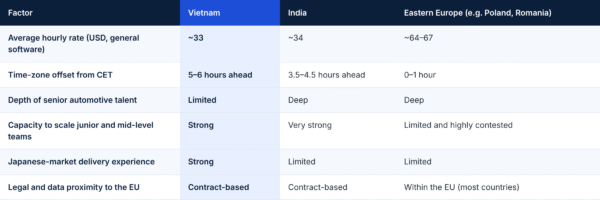
Table 1. Vietnam, India and Eastern Europe compared on rate and on the factors that drive total delivery cost (Source: hourly rates from Net Solutions, Offshore Development Rates (updated March 2026))
3.3 The senior-role premium shapes the optimal model
Compensation in Vietnam rises steeply at the senior end of the market, with median monthly pay of approximately VND 74 million for a Solution Architect and VND 58 million for a Tech Lead (ITviec, 2024–2025). The economic consequence is that Vietnam’s cost advantage is greatest in the broad base of implementation and verification roles, and narrower in the scarce senior roles, which is precisely why a blended model — senior governance in Europe, scaled execution in Vietnam — tends to deliver the strongest overall return.
Why this supports the thesis. The economic case for Vietnam is therefore robust but specific: it offers India-level cost with a different mix of strengths, and around half the cost of Eastern Europe, provided that the delivery model concentrates Vietnamese capacity where its cost advantage is largest.
4. Vietnam’s language profile supports European delivery and adds a distinctive Japanese dimension
In automotive programmes, a large share of defects originates not in code but in misunderstood requirements, and communication capability is therefore a direct determinant of delivery quality rather than a soft factor. The evidence indicates that Vietnam’s English capability is adequate for technical delivery, that its Japanese capability is a genuine differentiator, and that both can be verified before a commitment is made.
4.1 English proficiency is moderate overall and stronger in written technical work
Vietnam scored 500 on the 2025 EF English Proficiency Index, ranking 64th of 123 countries and returning to the “moderate proficiency” band (Tuổi Trẻ News, November 2025). In engineering practice, this national average conceals an important distinction: Vietnamese engineers generally read and write technical English competently, which is sufficient for specifications, tickets and code reviews, whereas spoken fluency in fast-paced requirements workshops and design reviews varies considerably between individuals.
4.2 Japanese capability gives Vietnam an advantage few competing locations share
Because Japan is a major client market for Vietnamese IT firms, many of them have built Japanese-speaking teams and employ bridge system engineers (BrSE), whose role is to translate both language and working conventions between client and team. For European Tier 1 suppliers that also serve Japanese OEMs, the availability of English-capable engineering teams alongside Japanese-speaking bridge roles within a single location is unusual and commercially valuable.
4.3 Communication risk can be measured before commitment
Unlike many location risks, communication capability can be tested directly and cheaply. A 30-minute technical session in which the proposed team lead and two engineers discuss one of the buyer’s own requirement documents in English will reveal far more than any conversation with the vendor’s sales staff, and it allows the buyer to decide whether additional bridge roles or written-first ways of working are required.
Vietnam’s language profile does not eliminate communication risk, but it reduces that risk to a level that can be verified in advance and managed through team design, while offering an additional Japanese capability that strengthens the case for suppliers with Japanese customers.
5. Vietnam’s structural gaps are real, but manageable through the design of the delivery model
The strongest objection to Vietnam as an automotive engineering delivery location is that the senior roles which define, assure and sign off automotive development are in short supply, and that the senior engineers who are available are the most exposed to turnover. A credible assessment must accept this objection rather than dismiss it; the evidence shows, however, that its consequences can be contained through the allocation of roles and a phased transition.
5.1 The senior gap is concentrated in four specific capabilities
The shortfall is not general but specific, which is what makes it manageable, since each gap corresponds to an identifiable role that can be covered from elsewhere:
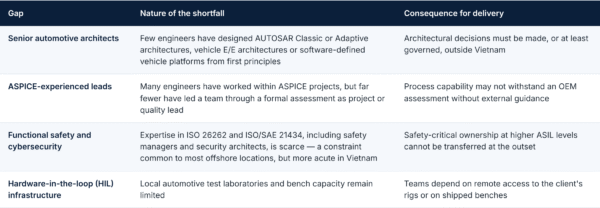
Table 2. The four senior-level capability gaps in Vietnam’s automotive engineering market and their consequences for delivery (Source: B&Company, ITviec (2024–2025) and Công Thương (July 2024))
5.2 Attrition pressure is strongest where programmes are most vulnerable
No reliable and recent public benchmark for IT attrition in Vietnam currently exists, and any vendor that quotes a precise market-wide figure should be asked to identify its source. The structural indicators nonetheless point in one direction: TopDev reported IT labour demand of 530,000 people in 2022 against a projected shortfall of 150,000 (B&Company), and pay rises fastest at the senior end of the market, as Argument 3 has shown. Because hiring for complex senior roles takes months rather than weeks, each unplanned departure at this level carries a disproportionate cost in lost knowledge and schedule, which is why buyers should request each vendor’s actual 12-month attrition on long-running client teams and secure key-person clauses and replacement service levels in the contract.
5.3 A role-allocation framework closes the gaps without sacrificing the cost advantage
Since each gap corresponds to a specific role, the most effective mitigation is to assign that role deliberately rather than expect the Vietnamese team to absorb it:
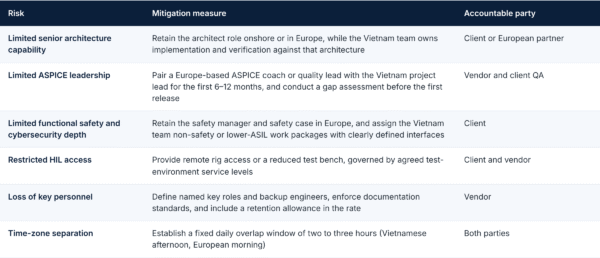
Table 3. Role-allocation framework for mitigating the risks of automotive engineering delivery in Vietnam (Source: NTQ recommended framework, aligned with the Automotive SPICE (ASPICE), ISO 26262 and ISO/SAE 21434 requirements discussed in this article)
5.4 A phased transition converts assumed capability into demonstrated capability
Because trust in a new delivery location should be earned through evidence rather than assumed, the transfer of work is most effectively structured in three phases:
- Pilot (3–4 months). The engagement begins with a single, well-bounded workstream, such as test automation or an engineering toolchain, against which defect rates, review quality and communication effectiveness can be measured objectively.
- Build (6–12 months). Once the pilot has met its criteria, application-layer development is added under the client’s architecture, ASPICE work products are introduced, and an internal assessment is conducted to establish the team’s process baseline.
- Scale (beyond 12 months). As process maturity is demonstrated, the team is expanded, local leads are developed under the client’s coaching, and progressively greater ownership is transferred to Vietnam.
The gaps identified in this argument do not disqualify Vietnam; rather, they determine the shape of the delivery model. Once senior governance is allocated deliberately and ownership is transferred in stages, the principal risk of the location is converted from an unknown exposure into a set of defined, contractually managed responsibilities.
Decision framework: is Vietnam the right engineering delivery location for your programme?
Vietnam represents a strong fit when the majority of the following conditions apply to the programme under consideration:
- Architectural and functional-safety ownership can remain in Europe.
- The scope is predominantly software-intensive, covering application layers, testing, tooling, or cloud and connected services.
- The programme requires junior and mid-level capacity to be scaled at a cost comparable to India.
- The organisation values a documentation-intensive, process-driven delivery style.
- The organisation also serves Japanese OEMs or partners.
- The programme can accommodate a five-to-six-hour time difference, provided that a fixed overlap window is maintained.
Conversely, where a programme requires a complete ECU development, including ASIL C or D ownership, to be transferred offshore from the outset, buyers should either consider an alternative location or adopt a hybrid model in which safety-critical ownership remains in Europe.
Due-diligence questions for prospective vendors
- On which automotive projects has the proposed lead worked, and what role did that person perform on each?
- Which members of the proposed team have taken part in an ASPICE assessment, and at what capability level was the project assessed?
- What has the vendor’s 12-month attrition rate been on long-running client teams, and how is that rate calculated?
- Which automotive tools and toolchains, such as Vector, dSPACE, Polarion or Jama, has the team used in production work?
- Through what process does the vendor onboard engineers into a client’s development and safety procedures?
Conclusion
The evidence reviewed in this article indicates that Vietnam merits a place on any automotive engineering delivery shortlist, since it combines substantial engineering scale, a cost position comparable to India, process discipline shaped by Japanese clients and a growing automotive presence. The same evidence also shows, however, that the market remains thin at the senior end, and that the organisations which succeed in Vietnam are those that design their delivery model around this limitation from the outset rather than discovering it during their first ASPICE assessment.
For organisations that are currently comparing delivery locations for an automotive programme, NTQ would welcome the opportunity to review the proposed scope together — to identify which work packages are well suited to Vietnam, which should remain closer to the client, and how a pilot delivered through a dedicated offshore development centre (ODC) could be structured. Arrange a scoping conversation with our automotive engineering team.
Read our latest article: Outsource Automotive Software: Top 5 Workloads to Scale
About us: https://ntq-europe.com/